Originally posted on solizresearch.com by Jordan Soliz:
I just recently watched a TED talk by Dr. Laura Carstensen, Director of the Stanford Center on Longevitiy, in which she discusses the research that shows people are actually happier as they age into older adulthood. What made this talk interesting and why I suggest people listen to it (or watch it) is that it goes against many of our attitudes about older adulthood and aging which are typically fairly negative. In fact, Dr. Mary Kite and her colleagues synthesized the research that compared people’s attitudes toward older and younger adults and, not surprisingly, found that we typically perceive younger adults more positively than older adults and still hold negative views toward older adults. Obviously, these negative attitudes have implications for how many people treat and interact with older adults just as we would expect when thinking about negative attitudes towards ethnic and religious groups. In fact, in one of his farewell addresses, the Archbishop of Canterbury made it a point to emphasize ending stereotypes and negative attitudes toward older adults (HT: Craig Fowler) as ageism remains a common form of prejudice. Yet, ageism does not receive the same amount of attention as other “isms.” But, beyond the significance of improving our attitudes toward older adults and aging for the sake of others, we should also do it for ourselves! Why? For two reasons. First, we all get older so improving attitudes toward older adults will only serve us well in the future. Second, we know that our attitudes toward aging are directly linked to happiness and well-being in later life. This is fairly intuitive--if I have negative views towards aging and older adults, I am more likely to meet this part of my lifespan with discouragement, pessimism, and, thus, have a higher chance for depression or a general negative outlook on life.
How do we improve these attitudes and recognize what Dr. Carstensen and others have discussed in terms of the positive side of aging and older adulthood? Our negative attitudes and stereotypes toward aging are pretty ingrained in us and we live in a culture which treats aging as something that should be avoided (i.e., “anti-aging”)… as if we have a choice! So, changing these perceptions and attitudes is easier said than done. Building off research focused on improving interethnic relations, scholars have examined if intergenerational contact can improve attitudes toward older adults and aging. In my own research, I have connected experiences with grandparents (which are fairly positive) with improved intergenerational attitudes. But, this only provides one piece of the puzzle. Much like our efforts towards reducing negative attitudes toward ethnic, religious, and cultural groups, we should be just as active in reducing ageist attitudes. This may be difficult or it may just be a matter of us being more discerning about what we see and experience and realize the variety of experiences involved in this thing called "aging." As I was reminded recently in discussions of their reunion tour on the radio, Mick Jagger is nearly 70 years old. Yet, he is still strutting around on stage singing about his lack of satisfaction among other things (quick side note: "Beast of Burden" is the best Stones' song). When we think of a 69-year old man, what comes to mind? Its probably not Mick Jagger---not likely, right? But, the question we should ask is: "why not?"
Tuesday, February 26, 2013

Monday, November 19, 2012
Israel, Gaza, and Intercultural Communication in a Networked Society


This week, we have seen an escalation of conflict in the Middle East specifically centered in the Gaza strip in Israel. In a recent CNN video, “Twitter as a Weapon in Gaza," the news outlet focused on the emerging role of Twitter in this conflict.
The report states that, in addition to traditional conflict, the “war is also fought online” as a battle for “public opinion” between Israeli forces and Hamas. Currently, the opposing forces are strategic in their use of social networking. For instance, the Israeli Defense Force is using #pillarofdefense and Hamas using #Gazaunderattack on their Twitter accounts as a method for allowing a global audience to follow the events from these oppositional perspectives. In addition to using these Twitter accounts to shape public (i.e., international opinion) and, at times, dialogue with each other, an unintentional outcome of the online nature of this conflict is that it allows for the global audience to become more engaged in the dialogue as individuals across the world respond to these messages in affirming or critical ways and, in doing so, often dialogue with others about these specific event and the ongoing tension in Israel, in general. Much like many of the event in recent years in the MidEast, Twitter and other social networking sites have changed, not only the nature of interactions between the groups directly involved in the conflicts, but also the global engagement and discourse surrounding international events.
Dr. Damien Smith Pfister and Dr. Jordan Soliz addressed this in their essay, “(Re)conceptualizing Intercultural Communication in a Networked Society” in the Journal of International and Intercultural Communication. Framing their ideas within the events and aftermath of the 2009 Iranian election protests, Drs. Pfister and Soliz argue that digital media (e.g., Twitter, YouTube) are changing the nature of how people are informed, persuaded, and, at times, become involved in the dialogue of intercultural and international events. As evidenced in this CNN video, this is no longer the exception but the norm as our networked society is bringing global events to our home offices, laptops, and mobile devices allowing everyone to be engaged in what, in times past, would be considered something happening in a “far-off place.”
Tuesday, November 6, 2012
COMM Careers Week, Day 1
The first day of COMM Careers Week was a smashing success. We went over to Career Services in the Union to learn about the different resources available to Communication Studies majors. Among the many resources we learned about was Husker Hire Link. Students workshopped their resumes, got practice giving their "elevator speech," and learned about networking resources.
Be sure to come to the Regency Room in the Union today (Tuesday) from 3:30-5:00 p.m. to hear why employers think Communication Studies is a great degree, and then drop by Room 202 in the Multicultural Center on Thursday, November 8, from 6:30-8:00 to hear from recent alumni!
There will be prizes!
.JPG) |
| Dr. Jody Koenig Kellas dropping some knowledge on peeps. |
 |
| Christina Fielder, Assistant Director of Career Services, explaining how they help students avoid ending up in their parent's basement. |
 |
| Just a glimmer of what we learned. |
 |
| A Communication Studies major learning how to scrub their Facebook account. |
 |
| We had a great turnout! |
Monday, October 22, 2012
Presidential Debate #3
Tonight marked the last presidential debate of the election season. This last debate focused on foreign policy with moderator Bob Schieffer.
Below are critiques about the debate from communication professors, students, and speech and debate members.
Daniel Wheaton, member of Cornhusker Forensics:
Jessy Ohl, PhD Student, Rhetoric and Public Culture:
Below are critiques about the debate from communication professors, students, and speech and debate members.
 |
| AP 2012 |
Daniel Wheaton, member of Cornhusker Forensics:
The strangest part of the final presidential debate was when both candidates agreed.
When it came to national security, relations with Israel and how to deal with China, the disagreement came in perspectives.
Both agreed to bolster our strength: either with a stronger navy or better technology. Both agreed to stand by Israel if Iran is able to get a nuclear weapon. Both agreed to stand firm on China's economic misdeeds.
As the debate went on, both candidates drifted towards the economy. Because the economy is most contentious issue in this election, the conversation drifted towards those issues regularly.
For policy hawks, this debate was blasé. Romney does not have enough foreign policy experience to adequately attack Obama. Without experience, Romney was backed into a corner by agreeing with the President.
 |
| AP 2012 |
Rhetorical critic Philip Wander has instructed that citizens and scholars should listen for which audiences and peoples are excluded in public addresses. The absence of any reference in the presidential debates to GLBTQ (Gay, Lesbian, Bisexual, Transgender, Queer) issues such as gay marriage or the ending of “Don’t Ask Don’t Tell” is incredibly significant. Critics of the first two debates had noted that GLBTQ rights had been left off of the docket. It was believed by many that in the third debate President Obama and Governor Romney would get the opportunity to discuss the inclusion of openly gay service members in the U.S. military. However, no question on the issue was asked and both Obama and Romney elected to completely avoid the subject. This decision is unlikely to satisfy gay voters which constitute a key voting block for Democrats.
Dr. Aaron Duncan, Speech and Debate Director:
In 1992 Bill Clinton famously put a sign on the door to his office at his campaign headquarters. It read simply, “It’s the economy stupid.” The phrase was meant to remind Clinton that no matter what the issue the real answer was America’s struggling economy. It appears that both Governor Romney and President Obama are students of history, because a debate that was supposed to focus on issues related to foreign policy turned on discussion of auto bailouts, stimulus packages, and protectionist vs free trade economic policies. In the end both candidates made clear that economy is really the answer to any and all questions this election season.
 |
| AP 2012 |
Dr. Aaron Duncan, Speech and Debate Director:
In 1992 Bill Clinton famously put a sign on the door to his office at his campaign headquarters. It read simply, “It’s the economy stupid.” The phrase was meant to remind Clinton that no matter what the issue the real answer was America’s struggling economy. It appears that both Governor Romney and President Obama are students of history, because a debate that was supposed to focus on issues related to foreign policy turned on discussion of auto bailouts, stimulus packages, and protectionist vs free trade economic policies. In the end both candidates made clear that economy is really the answer to any and all questions this election season.
Friday, October 19, 2012
Speech & Debate Wins Second Big Ten Title

The University of Nebraska-Lincoln Speech & Debate team finished atop the Big Ten Conference for the second year in a row by winning the Conference Challenge Tournament at Northwestern University October 13-14, 2012. In October 2011, Speech & Debate won the first Big Ten title as UNL became part of the Big Ten conference.
UNL led the field with a two-day point total of 190, finishing ahead of second-place Illinois (56 points), and third-place Northwestern (53 points). Northwestern hosted the event.
UNL students captured seven individual Big Ten titles:senior Lauren Schaal of Omaha in persuasive speaking, senior Marc Otero of Lexington in program oral interpretation, junior Amanda Stoffel of Raymond in after-dinner speaking, junior Josh Planos of Omaha in poetry interpretation, junior Grace Kluck of Lincoln in dramatic interpretation, sophomore Reece Ristau of Omaha and sophomore Josiah BeDunnah of Lexington in prose interpretation. BeDunnah and junior Roger Allen of Firth won in duo interpretation.
Wednesday, October 17, 2012
Presidential Debate #2
Tonight marked the second presidential debate for the 2012 election season. Obama and Romney met at Hofstra University in a town hall meeting debate, in which citizens asked the candidates their own questions regarding foreign and domestic policy.
Compiled below are nonpartisan critiques from communication experts, ranging from professors, graduate students, speech and debate coaches, and students.
 |
| AP 2012 |
Daniel Wheaton, member of Cornhusker Forensics:
The second act of political theatre had a very predictable plot— thanks to the political narrative.
These narratives provide heuristic shortcuts for readers of news. For example, Romney has been framed as an aristocrat while Obama has been framed as unable to complete some of his promises.
The debate furthered these narratives because each candidate used the context to attack one another.
Obama ended on the 47 percent comment while Romney brought up events that angered the GOP.
The outcome of the debate was very predictable thanks to the narratives. All Obama had to do to “win” the debate in the public eye was use his perfomative skills to “zing” Romney.
 |
| AP 2012 |
Professor Damien Pfister, Communication Studies, Rhetoric and Public Culture:
The second Presidential debate was modeled after a Town Hall format. Usually, such formats invite very little interaction between the candidates. This year, with a tight election and a perceived need to be "aggressive," President Obama and Governor Romney interacted with each other quite directly. Obama was much sharper in this debate stylistically and substantively. One of the turning points in the debate was Candy Crowley's instant fact check of Romney's claim that Obama didn't call the Benghazi consulate attack an act of terror, which he clearly did in a Rose Garden speech the day after. Romney scored some points, though he is likely to be remembered more for his "binders full of women" remark than his repetition of the unemployment rate.
I would make two observations after watching the CNN ticker of independent voters in Ohio (the ticker tracks positive and negative reaction to what the candidates are saying).
First, viewers don't like it when the candidates talk over each other and jockey for speaking time. Every time Obama and Romney got into it--and they were both guilty of wrangling for attention at different times--the negative sentiment increased dramatically. This might be a silver lining for the Obama camp, who were guilty of coaching their candidate to be too polite in the first debate. Independent voters especially want their politicians to behave like grown ups who can negotiate differences without throwing elbows.
Second, these viewers were apparently tired of the anecdotal style of the candidates. It seemed like every time Obama or Romney started off an answer to a question with something variant of "well, it reminds me of a woman I met in Middle, America, who was also struggling," the negative sentiment increased. Once they turned to policy specifics, the positive sentiment increased. There are probably a few ways to interpret this, but I think it stands as evidence that voters actually want information about policy specifics rather than an endless litany of heart-warming or bone-chilling stories. There's a place for stories of our fellow citizens' struggles and victories, but anecdotes are too easily parried with counter-anecdotes. Both candidates might be advised to abbreviate their anecdotes and get down to brass tacks in the final debate--and what a debate it is shaping up to be!
Monday, October 8, 2012
5 Questions with Audra Nuru
 |
| Photo: Audra Nuru Audra sipping some hot cocoa in Costa Rica! |
Audra recently went on a trip to Costa Rica to gain
experience working with multiethnic communities to help with her current
research. She describes her experience
in Costa Rica and what she learned in 5 questions below…
1. What are your
research interests?
I am interested in
understanding the communicative negotiation of multiple (and often contested)
identities. Most of my research focuses on understanding how multiethnic/racial
individuals communicatively negotiate and construct their racial/ethnic identities.
Through my research, I observe how people from multiple racial and ethnic
backgrounds negotiate both macro and micro discourses in order to develop an
understanding of who they are as well as develop ways to articulate who they
are to others. Specifically, I am interested in the ways multiethnic/racial
individuals use combinations of micro- and macro-level discourses in the
construction and negotiation of their identity.
2. Why Costa Rica?
Given
my research interests, I was specifically drawn to Costa Rica for data
collection because of its rich and incredibly diverse cultural makeup. I
gathered most of my data from Puerto Viejo and San Jose because I was
interested in observing perspectives of multiethnic/racial identity from
Latino, Afro-Caribbean, and Bribri indigenous cultures. After talking with my
doctoral advisor, Dr. Jordan Soliz, and my mentor, Dr. Tina Harris, I realized
that gaining an international perspective on ethnic/racial identity negotiation
is crucial in understanding the process of multiethnic/racial identity
construction. As I discussed my ideas with both Drs. Soliz and Harris, Dr.
Harris introduced me to the study abroad program that she directs through the
University of Georgia-Costa Rica titled, “International Perspectives on Interracial
Communication.” She explained that through this particular study abroad program
I would have access to these unique populations and would be able to study the
intersections of race, ethnicity, culture, and communication within national
and international contexts. It honestly seemed too good to be true! I
immediately applied to the program and the rest is history!
3. What was the most exciting part of your trip?
I really did enjoy everything
about the trip! It was such an amazing opportunity, and I am so incredibly
grateful for the experience. While there were many “exciting” parts of the
trip, I think my top two are: 1) learning from and interacting with indigenous
tribes in otherwise secluded territories, and 2.) being invited to guest
lecture about multiethnic/racial identity and the Communication Theory of
Identity at the University of Costa Rica-San Ramon.
4. What difficulties did you come across in
your trip?
Honestly, I think the most
difficult part about the trip was going home. I established such amazing
relationships with the people there and it was incredibly difficult to say
goodbye. The people I met and the stories they shared have forever changed my
disposition towards life, research, and teaching; and while I know it won’t be
too long until I can return, I honestly can’t wait to go back!
5. What advice do you have for future students
interested in going abroad for research?
Do it! It was such an amazing
opportunity and it has enhanced my life in ways I could have never imagined. However,
if you plan on collecting your research in Costa Rica, remember to pack some
bug spray!
Wednesday, October 3, 2012
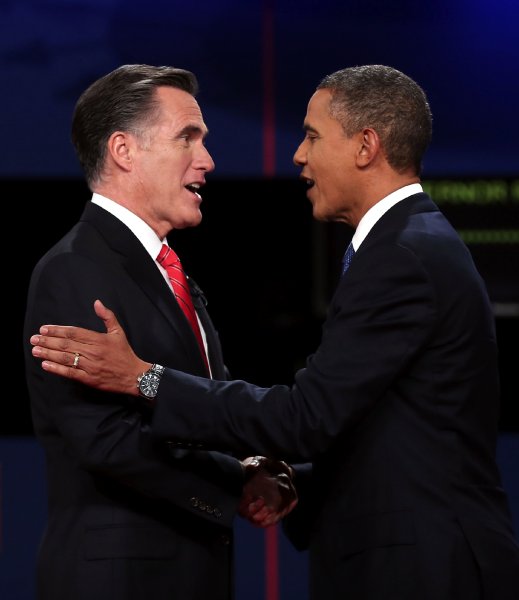
The First Presidential Debate 2012
 |
| Photo: AFP |
Professor Pfister, Rhetoric and Public Culture:
The format of this debate was a disaster. The moderator Jim Lehrer's
attempts to move things along were half-hearted, and he was ultimately
run over by the candidates. It's unfortunate, because there were
several "segments" that could have been discussed more in depth. That
said, a more freewheeling exchange did enable Obama and Romney to
provide rich contrasts between their respective positions. The
candidates' approach to the debate was evidenced by the direction they
looked: Romney usually looked straight at Obama, attacking his policy
directly; Obama usually looked right at the camera, appealing to the
American people.
Mitt Romney was--as expected, and as needed--fairly aggressive in the
debate. While we were primed to hear some real "zingers," no line was
nearly as memorable as "there you go again." Romney was very good on
specifics--identifying regulations he thought were unnecessary and
suggesting changes in the tax code that might stimulate job growth.
The problem for Romney in this debate is that many of his positions
have seemed to shift again--if the Obama campaign is smart, they will
run advertisements that compare Romney's positions in the debate with
his positions on the campaign trail, with his positions in the
Republican primary, and with his positions when he was governor of
Massachusetts.
Barack Obama's performance was classic "don't lose the game." Ahead in
most major polls and in the battleground states, Obama was
(ironically) conservative in his approach to the debate. The strongest
point for Obama came when he pressed on Romney's proposed
alternatives: what would Romney do to replace the regulations on Wall
Street? or how would Romney replace the Affordable Care Act (aka
Obamacare)? what deductions would Romney eliminate in order to pay for
his tax cuts? Obama's line about how Romney's plans must be so good
for the middle class that we can't talk about them is perhaps the most
memorable line of the night. But compared to Romney's energy, Obama
seemed listless and disengaged. Expect the Romney campaign to pounce
upon the need for new energy to revive bipartisan cooperation to solve
America's most pressing problems.
 |
| Photo: Rick Wilking, AP |
Jessy Ohl, PhD Student in Rhetoric and Public Culture:
The most astute analysis that I heard of the first presidential debate came from CBS news anchor Scott Pelley immediately after the closing remarks when he stated “the only casualty tonight was the format.” Supports of both candidates should agree that the first debate was not particularly productive from a democratic standpoint. Neither side seemed willing to answer direct questions, list specifics, or follow the agreed upon time limits. Ultimately, the American voter was the loser of the first debate.
Dr. Aaron Duncan, Director of Speech and Debate:
The first presidential debate did as much to point out the problems inherent in our media system, as did to inform us about the differences between Barack Obama and Mitt Romney. In a night when both candidates kept closely to script and gave truncated versions of their stump speeches, members of the media chose not to than discuss the substantive differences between the two the debate highlighted, but rather chose to focus on questions like “who had more energy?” and “whose answers sounded the crispest?” The later being an especially odd choice, since it evaluates presidential candidates on the same scale used to evaluate lays potato chips. Let’s hope that voters are more concerned with policies than potato chips when casting their ballots this November.
Daniel Wheaton, Daily Nebraskan:
The first presidential debate on Oct. 3, had each candidate focus on different frames. Gov. Mitt Romney attacked with specifics, while President Barack Obama defended with generalities. Through the entire debate, Romney provided specifics on his economic policy and his opinions on healthcare and education. Riding off of a stream of gaffes, Romney used this opportunity to regain momentum lost during September. When asked about the deficit, Romney described it as a “moral issue.” Romney’s attacks followed the traditional Republican method. He voiced his support for fewer regulations, lower taxes and a diminished role of government. Obama repeatedly used emotional arguments to support his points, aiming to draw in less political audiences. Obama and Romney appeared to be gunning for different audiences: Romney was looking to convince moderates and liberals disenfranchised by the past four years, while Obama sought to convince people less involved in the process. This debate appears to be a draw. This boils down to the fundamental differences between each person’s economic or social opinions.
 |
| Photo: Getty Images |
Stay tuned as we are continuing to add more critiques! Be sure to also add your own comments below!
Thursday, September 27, 2012
Watch our very own Kathy Castle...
...featured on Faculty and Student Technology (FAST) talking about technology in the 286 classroom.
Friday, September 14, 2012
Congratulations to Dr. Kellas and Dr. Breshears on Recent Awards

Kellas Awarded Arts & Sciences Enhancing Research Excellence Grant
Dr. Jody Koenig Kellas was awarded a UNL College of Arts & Sciences Enhancing Research Excellence Grant for Fall 2012. These grants are designed to assist faculty members in their research, scholarship, and/or creative endeavors to help them start, move forward, or complete a well-defined research project. The program is aligned with the UNL Chancellor’s ambitious goals of increasing research productivity and external funding for research and scholarly activities. This is the inaugural year of this program and only four awards were made in the College of Arts & Sciences.

Recent Ph.D. graduate wins award and post-doc position
Diana Breshears (Ph.D. 2011) has been awarded a competitive post-doctoral position at the University of Pretoria (South Africa) Department of Educational Psychology. She will be studying the school experiences of children with lesbian and gay parents and designing materials and/or workshops, based on her findings, to help schools create a more supportive environment for same-sex parented families. Dr. Breshears was also awarded the Sandra Petronio Dissertation Award from the Family Communication Division of the National Communication. This is the 8th year of the Petronio Award and UNL doctoral graduates have won half of the awards!
2012 – Diana Breshears (University of Nebraska)
2011 – Elizabeth Munz (Purdue University)
2010 – Naomi Kagawa (University of Minnesota)
2009 – Carla Fisher (Pennsylvania State University)
2008 – Karla Bergen (University of Nebraska)
2007 – Meredith Marko Harrigan (University of Nebraska)
2006 – Rene Dailey (University of California, Santa Barbara)
2005 – Paul Schrodt (University of Nebraska)
Subscribe to:
Posts (Atom)